
Narrative and Representation & Ideology
V for Vendetta (McTeigue, 2005)
V for Vendetta - http://www.youtube.com/watch?v=sCiGyaSPRhI
- In the opening scene of V for Vendetta the narrative is structured with the continuous use of a voiceover from the television presenter between the parallel storylines of Evey (Natalie Portman) and V (Hugo Weaving). This tells the audience that each character's actions are going on within the same time period. Certain enigma codes, such as V's Guy Fawkes mask, inform the audience that V must be some sort of outcast, and the mask also makes it difficult for the audience to form an opinion of V as the mask hides his identity making him seem unreachable. However the audience is very easily positioned with Evey and the TV presenter, Lewis. Evey represents the normal, law-abiding, innocent citizen and so the audience sides with her. Lewis on the other hand, repels the audience as he is the face of a racist, authoritarian, and bigoted state. It is the voiceover that really drives the narrative and introduces the themes of the film - themes of dictatorship, fear, and revolution. Most of the tension in the opening scene is created by V preparing himself for his nightly excursion where the audience sees all manner of knives being equipped. The tension is maintained with the voiceover because it maintains continuity and builds momentum.
V for Vendetta is also a great film to analyse for representation and ideology because the film has a large political dimension. The most obvious values and beliefs portrayed in the opening scene are those of the TV presenter, Lewis, who is clearly prejudiced, racist, fiercely Christian, and bigoted. His views represent his own interpretation of Christianity which is to fear God. He believes that the (former) United States fell because of its 'Godlessness', and he expresses sheer disgust at anyone who isn't white, British, and Christian. However Evey's values and beliefs are shown to be quite the opposite of Lewis's. Where Evey says "That's quite enough of that, thank you very much", it implies that she is fed up of hearing Lewis's opinions because she 100% disagrees with them. V, being the outcast he is, is also shown to hold views that contradict those of Lewis. Evey, who represents the normal middle/working class citizen, isn't shown to have a 'voice' implying that all traces of democracy and people power have vanished. This is again backed up by Lewis who represents the ruling party, the social elite, being shown to have by far the strongest voice.
Genre and Audiences
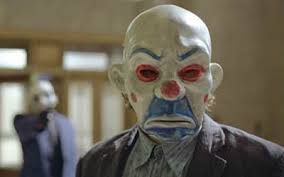
The Dark Knight (Nolan, 2008)
The Dark Knight - http://www.youtube.com/watch?v=0OYBEquZ_j0
The Dark Knight (Nolan, 2008)
The Dark Knight - http://www.youtube.com/watch?v=0OYBEquZ_j0
- The opening scene of the Dark Knight immediately alerts the audience to its genre. An audience's expectations of a thriller consist of such things as guns and vehicles crashing through walls. And in the opening scene of the Dark Knight these expectations are immediately fulfilled as the opening scene features a bank robbery. Thriller are, of course, meant to be thrilling and the early use of things such as gunfire and a bus crashing through the wall does induce excitement and thrills for the audience. The Dark Knight seems to fully conform to the characteristics of the thriller genre and so the audience's generic expectations are totally fulfilled.
- The Dark Knight was a tentpole and so it was naturally targeted towards the four quadrants - despite its age rating. As a British teenager my reading of the film is that it is tense and exciting and a very clever film. My reading of a film opening would of course be influenced by my age, gender, and background. It is stereotypical that boys enjoy guns and car crashes in films but I think my background influences my reading of this media text more than anything else. Coming from quite a privileged background with a grammar school education I am more aware than the 'Die Hard' audiences who just like seeing buildings exploding and Bruce Willis getting shot several times yet somehow surviving. The Dark Knight has a very clever plot with a few twists and the tension is maintained throughout, and that is why I appreciate this film.
Film Language and Institutions
Inception (Nolan, 2010)
Inception - http://www.youtube.com/watch?v=-VXkUzf1et4
Inception (Nolan, 2010)
Inception - http://www.youtube.com/watch?v=-VXkUzf1et4
- The mise-en-scene in the opening scene of Inception is all over the place which is fitting as Inception is set in the eternal and limitless world of dreams. The fact that upon being introduced to the old Japanese man, Saito, the audience doesn't get to see his face, and this portrays him as an important figure. The zoom in on the spinning top, as well as Saito's reaction upon being presented it, makes that object symbolic and gives the audience the feeling that the symbolism it holds will be of great value and importance throughout the film. As Dom (DiCaprio) is lying in the water the use of a POV shot along with the camera zooming in slightly and blurring slightly, then zooming back out suggests that Dom is dazed and weak. The non-verbal language of Dom as he lies in the waves and then later is stuffing is face with food also shows that he is weak, hungry, and vulnerable. However, as the shot changes to show the same location - only in a different time - the audience sees a confident and neat Dom, pitching himself to Saito who this time, is only a lot younger. This puzzles the audience after just seeing a really old Saito and a young Dom, to seeing the same age Dom, but a younger Saito. A tiny bit further on in the scene the picture displays a watch ticking. The sound of the watch ticking seems exactly like a bomb ticking down and then, the audience is swept away to another completely different location straight as a bomb goes off. This provides a nice little visual and audio link.

- Inception was distributed by Warner Bros. and had a budget of $160 million so it is obvious that it was an industrial film. The film's main character is Dom Cobb, played by Leonardo DiCaprio. Leonardo DiCaprio is a highly bankable actor having appeared in what is the second highest grossing film of all time, Titanic. It can be important for filmmakers to cast highly bankable actors/actresses in their films because many people are attracted to see a film if it stars one of their favourite actors or actresses, thus bringing in more revenue for everyone involved on the financial side of film-making. As mentioned Inception was an industrial film and it's industrial status is evident in the opening sequence as there are expensive sets on display as well as Academy Award winning special effects towards the end of the sequence. Couple that together with the huge budget and the international ensemble cast and it is clear to see that Inception was an industrial film.


No comments:
Post a Comment